
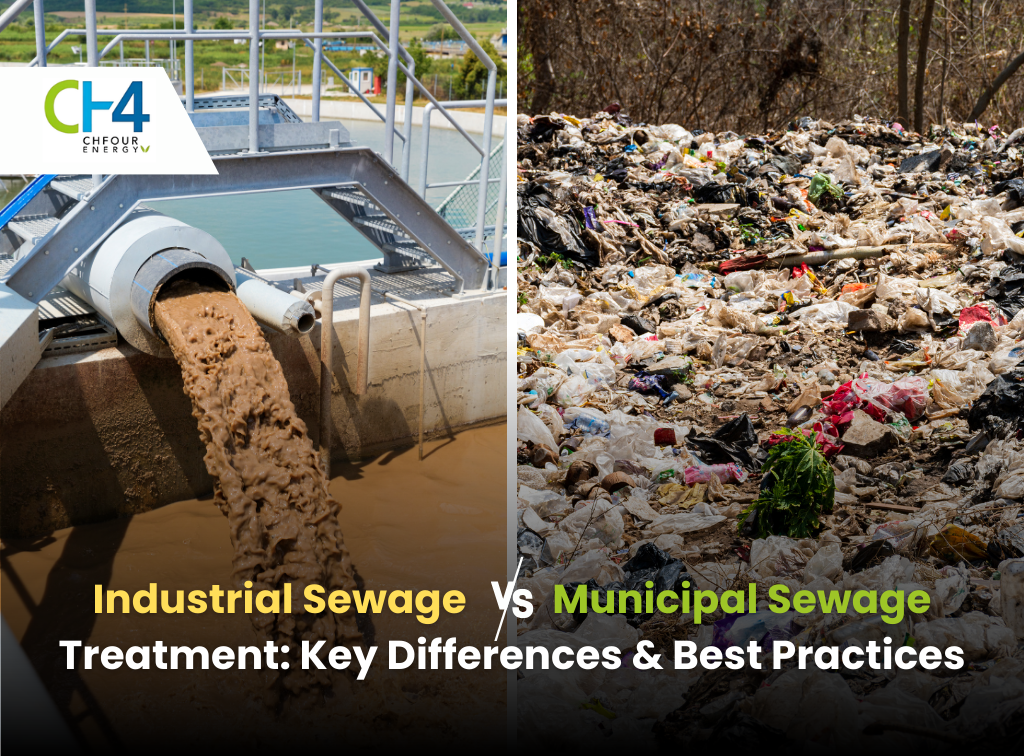
Over 70% of India’s industrial wastewater is discharged without adequate treatment, a statistic that carries serious consequences for public health, river ecosystems, and regulatory compliance. Yet many facility managers, plant operators, and project developers still lack clarity on a foundational question: What is the actual difference between municipal and industrial sewage treatment, and which system does my project need?
The answer lies in understanding the source, composition, and complexity of the wastewater being generated and matching it to the right treatment infrastructure.
In this guide, we break down exactly how a Sewage Treatment Plant and an Industrial Effluent Treatment Plant differ in design, process, technology, and compliance requirements, along with best practices to help you run either system effectively.
What Is Sewage Treatment and Why Does It Matter?
Sewage treatment is all about cleaning up wastewater so it can be safely released back into the environment or even reused for other purposes. When sewage isn’t treated, whether it comes from homes or industries, it can lead to serious problems like contaminating groundwater, spreading waterborne diseases, polluting rivers, and facing legal trouble under India’s Environmental Protection Act of 1986.
In India, the Central Pollution Control Board (CPCB) and State Pollution Control Boards have set strict discharge standards for both municipal and industrial wastewater. If these standards aren’t met, it can lead to show-cause notices, shutdowns of facilities, and hefty fines. This makes proper sewage treatment not just an environmental duty but also a crucial aspect of running a business.
The way wastewater is treated can vary quite a bit, depending on whether it comes from households or industrial activities.
What Is a Sewage Treatment Plant?
A Sewage Treatment Plant is a facility specifically built to handle the wastewater produced by homes, businesses, hotels, hospitals, schools, and local governments. This wastewater, often called domestic sewage, mainly consists of organic materials, suspended solids, harmful pathogens, nitrogen, and phosphorus.
The main goal of a Sewage Treatment Plant is to lower the concentration of pollutants to a level that is safe for releasing into natural water bodies or for reuse in non-drinking applications like watering landscapes, flushing toilets, and replenishing groundwater.
Treatment Stages in a Sewage Treatment Plant
Preliminary Treatment – Incoming wastewater passes through bar screens to remove large solids like rags and plastic, followed by grit chambers that settle out sand and inorganic particles. This protects downstream equipment from damage and wear.
Primary Treatment – The screened wastewater enters primary clarifiers, where gravity sedimentation separates settleable solids from the liquid. The accumulated primary sludge is collected separately for further processing. This stage removes approximately 50–70% of suspended solids.
Secondary Treatment – Biological treatment forms the core of any Sewage Treatment Plant. Microorganisms break down dissolved organic matter using oxygen. The most widely used technologies in India include the Moving Bed Biofilm Reactor (MBBR), Sequencing Batch Reactor (SBR), Activated Sludge Process (ASP), and Membrane Bioreactor (MBR), each suited to different capacity and reuse requirements.
Tertiary Treatment – Post-biological treatment, the water is polished through sand or multimedia filtration and disinfected using UV irradiation or chlorination. This stage is essential when treated water is intended for reuse and must meet stringent quality standards.
Sludge Treatment and Disposal – Sludge collected across all stages is thickened, dewatered using filter press or centrifuge equipment, and disposed of or reused in compliance with CPCB guidelines, either through composting or authorized landfill.
Where Are Sewage Treatment Plants Commonly Used?
Sewage Treatment Plants are deployed across a wide range of applications including residential townships, gated communities, hospitals, hotels and resorts, commercial complexes, and municipal corporations managing city-level wastewater.
What Is an Industrial Effluent Treatment Plant?
An Industrial Effluent Treatment Plant is a unique wastewater treatment system specifically designed to handle the effluent produced by manufacturing and industrial activities. Unlike regular household sewage, industrial effluent is a much more complicated and hazardous mix of pollutants, including heavy metals, toxic chemicals, oils and greases, high levels of BOD and COD, solvents, synthetic dyes, and both acidic and alkaline compounds.
A typical Sewage Treatment Plant just isn’t equipped to deal with this kind of complexity. That’s why an Industrial Effluent Treatment Plant needs to be custom-built to match the specific waste profile, volume, and discharge needs of the industry it supports. This makes it a highly specialized and tailored infrastructure solution.
Treatment Stages in an Industrial Effluent Treatment Plant
Collection and Equalization – Industrial effluent from various production units is collected in an equalization tank, which buffers fluctuations in flow rate, temperature, pH, and pollutant concentration, ensuring a consistent feed to downstream treatment processes.
Physico-Chemical Treatment – This stage employs chemical and physical mechanisms to remove pollutants that cannot be addressed biologically. Coagulation and flocculation bind fine suspended particles into larger flocs for removal. pH neutralisation adjusts acidic or alkaline streams to an optimal range. Dissolved Air Flotation (DAF) separates oils, greases, and fine suspended solids, particularly important in food processing, dairy, and petroleum industries.
Biological Treatment – Depending on the organic load and effluent characteristics, aerobic or anaerobic biological treatment is applied. Aerobic processes using MBBR, SBR, or ASP are effective for moderate organic loads. Anaerobic treatment using Upflow Anaerobic Sludge Blanket (UASB) reactors handles high-strength organic effluent and generates biogas as a recoverable by-product.
Advanced Treatment – Industries with stringent discharge norms or water reuse goals require additional treatment stages. Reverse Osmosis (RO) removes dissolved salts and micro-pollutants. Activated Carbon Filtration (ACF) eliminates colour, odour, and trace organic compounds. Membrane Bioreactor (MBR) combines biological and membrane filtration for premium effluent quality.
Zero Liquid Discharge (ZLD) – ZLD is increasingly mandated by CPCB for industries in water-stressed zones, including textiles, pharmaceuticals, and tanneries. In a ZLD system, all wastewater is treated and recovered with zero liquid effluent discharged. Concentrate from RO is processed through Multiple Effect Evaporators (MEE) and Agitated Thin Film Dryers (ATFD) to produce dry solid waste liminating liquid discharge.
Industries That Require an Industrial Effluent Treatment Plant
An Industrial Effluent Treatment Plant is essential across pharmaceuticals and API manufacturing, textile and dyeing units, chemical and petrochemical plants, food and beverage processing, dairy operations, paper and pulp mills, and metal finishing and electroplating units.
Industrial Effluent Treatment Plant vs Sewage Treatment Plant: Key Differences
| Parameter | Sewage Treatment Plant | Industrial Effluent Treatment Plant |
| Wastewater Source | Domestic, residential, commercial | Factories, manufacturing, processing industries |
| Key Pollutants | Organic matter, pathogens, nutrients | Heavy metals, chemicals, high BOD/COD, dyes, toxins |
| Treatment Design | Standardized process | Fully customised per industry and waste profile |
| Core Technologies | MBBR, SBR, ASP, MBR | Physico-chemical + biological + advanced treatment |
| ZLD Requirement | Rarely applicable | Increasingly mandated for specific sectors |
| Regulatory Framework | CPHEEO, State PCBs | CPCB, State PCBs under EPA 1986 |
| Operational Complexity | Moderate | High — variability composition demands adaptive systems |
| Typical End Use | Discharge or water reuse | Regulatory compliance + ZLD where required |
The fundamental distinction is this: a Sewage Treatment Plant follows a largely standardised process suited to predictable domestic wastewater, while an Industrial Effluent Treatment Plant demands custom engineering because no two industries generate the same effluent.
Common Operational Challenges
Understanding the regulatory landscape is essential to ensure sewage treatment plants operate safely, meet environmental standards, and comply with government guidelines.
Regulations for Sewage Treatment Plants
Municipal and institutional STPs in India are governed by the Central Public Health and Environmental Engineering Organisation (CPHEEO) guidelines and the discharge standards set by respective State Pollution Control Boards. Residential societies, hotels, and hospitals above a prescribed size are legally required to install and maintain a functional Sewage Treatment Plant and must obtain Consent to Operate (CTO) from the State PCB.
Regulations for Industrial Effluent Treatment Plants
Industrial units must comply with discharge standards prescribed under Schedule VI of the Environment Protection Act, 1986, and sector-specific norms issued by CPCB. Obtaining Consent to Establish (CTE) and Consent to Operate (CTO) from the State PCB is mandatory before commissioning any Industrial Effluent Treatment Plant. Industries in notified water-stressed zones are additionally required to achieve ZLD as a condition of their operating consent.
How CH Four Energy Solutions Approaches Wastewater Treatment
CH Four Energy Solutions, established in 2008 and headquartered in Pune, is one of India’s experienced wastewater treatment companies, with over 1,500 completed projects across industrial, institutional, and municipal sectors.
Sewage Treatment Plant Solutions
CH Four specializes in designing and delivering Sewage Treatment Plants tailored for residential townships, hospitals, hotels, and municipal needs, with capacities that range from 10 KLD to large multi-MLD installations. Their STP solutions utilise reliable technologies like MBBR, SBR, and MBR, carefully chosen based on the specific capacity requirements of each site, space limitations, and goals for reusing treated water.
Industrial Effluent Treatment Plant Solutions
CH Four’s engineering team specializes in creating fully customized Industrial Effluent Treatment Plants. They kick off each project with thorough effluent characterization studies to ensure the design is spot on. Their impressive industrial portfolio includes everything from primary physico-chemical systems and biological treatment to advanced polishing and complete Zero Liquid Discharge (ZLD) plants, featuring Multi Effect Evaporators (MEE) and Agitated Thin Film Dryers (ATFD). These systems are built to meet long-term compliance with the Central Pollution Control Board (CPCB) and State Pollution Control Board (PCB) regulations, serving a variety of sectors like pharmaceuticals, chemicals, textiles, and food processing.
End-to-End Project Delivery
Every CH Four project takes a comprehensive approach, covering everything from the initial feasibility study to process design, equipment manufacturing, installation, commissioning, operator training, and even Annual Maintenance Contracts (AMC). We also handle all the necessary regulatory interactions with the MPCB and CPCB. What sets us apart is that no two systems are the same; each solution is meticulously crafted from scratch, tailored to meet the unique wastewater characteristics, site limitations, budget, and compliance needs of our clients.
Conclusion
Wastewater treatment is not a compliance checkbox it is a long-term investment in environmental sustainability, operational continuity, and regulatory security. Whether you are managing a residential complex that needs a reliable Sewage Treatment Plant or running an industrial facility that requires a technically rigorous Industrial Effluent Treatment Plant, the performance of your system depends entirely on the quality of its design, engineering, and ongoing management.
Regulations in India are becoming stricter. Environmental accountability is rising. And the cost of non-compliance, financial, legal, and reputational, continues to grow. The right time to invest in a properly engineered wastewater treatment system is before a problem arises, not after.
CH Four Energy Solutions brings 15+ years of hands-on expertise, 1,500+ successfully delivered projects, and a fully integrated approach that takes your wastewater challenge from initial assessment to long-term compliance.