
Water is an essential component, in fact, the lifeline of all existence on earth. Therefore, access and availability of water for a variety of purposes are an absolute must for public health and welfare, as well as for communities and industry, and for effective wastewater treatment, such as Sewage Water Treatment Plant manufactured by wastewater/sewage water treatment companies. And not to forget, safe drinking water treatment & management for all.
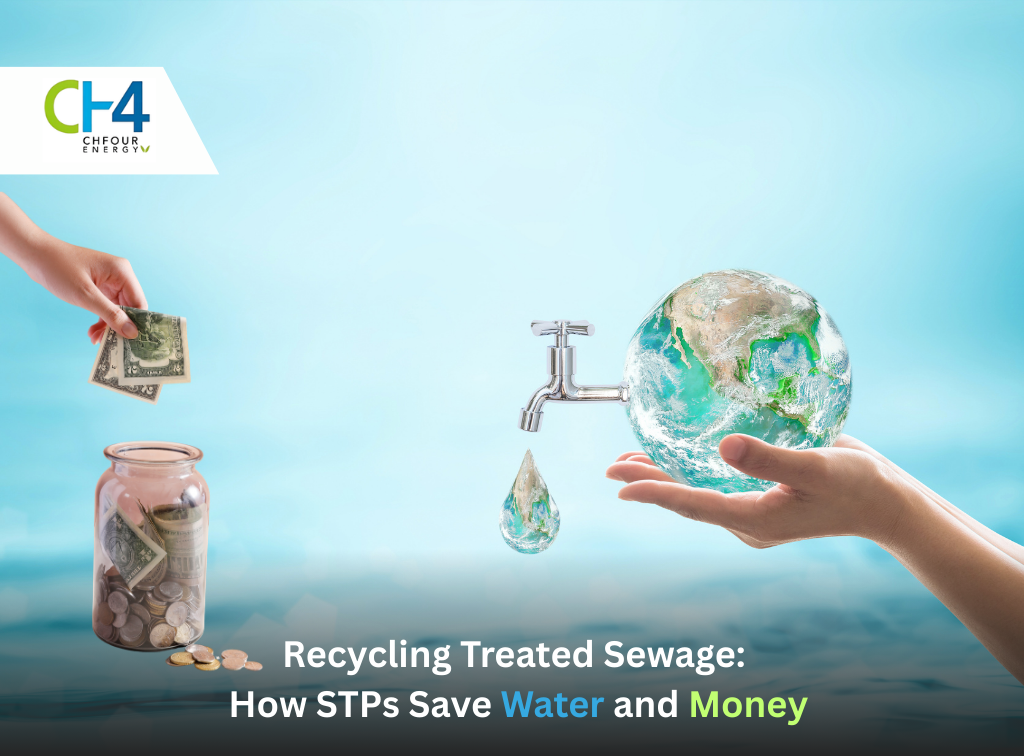
In fact, wastewater treatment saves water and money, supports recycling treated wastewater to improve the environment, and is well-suited for industrial applications. It does so by using a Sewage Treatment Plant manufactured by wastewater treatment companies, thereby providing a sustainable, non-potable source for flushing, gardening, and industrial cooling, minimizing freshwater demand by up to 50%. It also saves money by lowering municipal water bills, reducing dependency on costly water tankers, and preventing high environmental fines.
Enter CH Four Energy Solutions, one of the prime wastewater treatment companies in Pune, Maharashtra, India, manufacturing Sewage Water Treatment Plant, handling industrial recycling of treated sewage, and regulating them accordingly, to the benefit of the environment, industry, and people at large.
How Sewage Treatment Plants Help You Save Water & Reduce Costs
Significant Water Reduction – Sewage Treatment Plant (STPs) in apartment buildings can treat 80-90% of wastewater, which is thereafter repurposed for flushing out (covering 40% of water usage) or irrigation, drastically minimizing fresh water consumption.
Reduced Utility Bills – Utilizing STP for gardening, parks, and cleaning noticeably lowers monthly utility bills by eliminating the need for municipal water.
Lowered Operational Expenses – Industries, hotels, and commercial buildings or establishments can save money by using treated wastewater for cooling systems and vehicle washing.
Financial Return on Investment – Whilst there is an initial cost, an STP is a long-term investment that pays for itself by minimizing water expenses and avoiding penalties for discharging untreated sewage into the environment.
Sustainable Resource Recovery – Beyond water, advanced, start-of-the-art treatment may aid in recovering nutrients from fertilizers, thereby fostering a circular economy.
Key Applications of Sewage Treatment Plants
- Residential – Toilet flushing-out, gardening, and car washing.
- Commercial/Industrial – Cooling towers, floor cleaning, irrigation, and processing.
STPs Working Mechanisms Followed by CH Four
- Primary stage involving segregating solids from liquids.
- Sewage is then pumped into sedimentation tanks, where gravity forces solids to the bottom of the tanks.
- Thereafter, the water is released, leaving behind a sludge/slurry.
Chemicals Used in Sewage Water Treatment Plant
- Flocculants (Polyaluminium Chloride, Alum)
- Coagulants (Ferric Chloride)
- Disinfectants (Chlorine, Sodium Hypochlorite)
- pH adjusters (Caustic Soda, Lime, Sodium Bicarbonate)
- Biological agents (enzyme/bacteria cultures)
- Decolorizers
- Anti-foaming agents
- Activated carbon
As of early 2026, STP compliance in India entails a strict, performance-oriented mandate driven by the Central Pollution Control Board (CPCB) and National Green Tribunal (NGT), having focus on 100% wastewater reuse, real-time surveillance, and strict effluent quality, specifically for residential, commercial/industrial, and hospitality sectors.
Key 2026 Regulatory Mandates
- Stringent Discharge Norms (New & Old STPs) commissioned post June 1, 2019, should abide by strict limits, to be enforced in 2026:
- BOD (5th day): <=10 mg/L
- COD: <=50 mg/L
- TSS: <=10 mg/L
- pH: 6.5-8.5
- Fecal Coliform: <100 MPN/100 mL
- Mandatory Treated Water Reuse – Municipalities are enforcing treated wastewater reuse for non-potable purposes like gardening, toilet flushing, and cooling towers. Discharge without reusage is undesirable or penalized.
- Online Monitoring – Real-time, online effluent quality monitoring systems/mechanisms for BOD, COD, TSS, pH, and flow are increasingly needed for large and mid-sized projects, with data being directly sent to SPCBs.
- Consent to Operate (CTO) Renewals – State Pollution Control Boards (SPCBs) are conducting daily inspections and discarding non-performing/incompetent STPs. CTO renewal relies on maintaining strict logbooks & water-quality data.
Sector-Specific Updates
- Housing Societies – In cities like Mumbai, STPs are compulsory for projects with 50+ units, with strict enforcement of occupancy certificate requirements. In fact, Pune has implemented stringent water cuts for societies without functional STPs, effective June 2025.
- Hospitals & Healthcare – All hospitals, clinics, and labs are needed to install STPs with 2025/2026 standards enforcing high-level treatment owing to hazardous waste, along with strict pathogen removal.
- Commercial/IT Parks – Focus is on Zero Liquid Discharge (ZLD) systems and compact, modular, or Membrane Bio-Reactor (MBR) technology for tackling variable loads in restricted space.
Compliance Checklist for 2026
- Permits – Get valid Consent to Establish (CTE) and Consent to Operate (CTO) from SPCB.
- O&M – Regular maintenance of pumps & blowers, and daily surveillance of sludge management.
- Documentation – Maintain mandatory operational logs and water quality data for inspection.
- Safety – Ensure appropriate ventilation and odor control, like biofilters/activated carbon filters.
Consequences of Non-Compliance
- Penalties – Fines starting at Rs.50,000 for non-compliant Sewage Water Treatment Plant.
- Suspension – Immediate shutdown of non-compliant plants.
- Water Cuts – Municipalities are entitled to stop water supply to complexes for sewage treatment failure.
- Legal Action – Stringent legal action by NGT against non-compliant proprietors and builders.
However, regulations tend to vary by state. So, it is advisable to check the specific SPCB norms update for your locations.
Importance of MPCB Liaison Services in Wastewater Treatment Projects
- Expert Guidance with complex laws & rules, compliance with industrial/commercial wastewater & contaminant control requirements.
- Comprehensive & Seamless Documentation, including applying for MPCB approvals and licenses, in-depth report preparation, site plan compilation, etc.
- Proactive Risk Mitigation through potential risks identification & compliance gaps.
- Effortless Coordination with the organization’s officials, presenting cases clearly, addressing queries promptly, and following up on application concerns.
- Continuous Compliance Monitoring of the company’s compliance, carrying out audits and inspections, handholding every stage of the journey, enabling one sustainably comply.
- Pollution & Contaminant Control & Managing Guidance implementing effective pollution and contaminant control measures.
- Focus on Core Business by tackling environmental & pollution control compliance on one’s behalf, freeing up time to focus on other core business aspects.
Consider CH Four Energy Solutions as Your Ultimate Solution Provider & Get Rid of All Your Worries & Concerns!
Connect with Our Specialists Via Email at info@chfour.net