
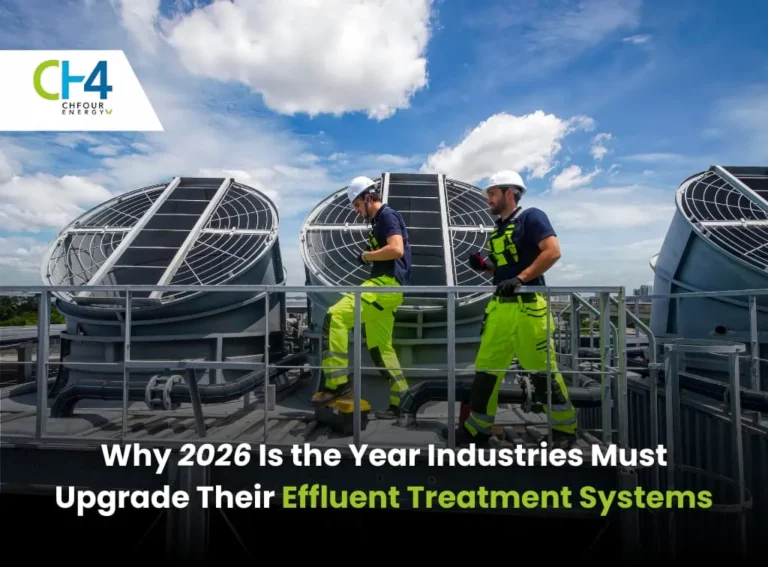
Effluent treatment systems, or an Effluent Treatment Plant (ETP), are industrial systems designed to purify wastewater by removing harmful and hazardous chemicals, organic matter, heavy metals, oil, and grease. They employ a blend of physical, chemical, and biological procedures ensuring treated water meets environmental standards and regulations before discharge or reuse. Common steps include preliminary screening, primary sedimentation, secondary biological treatment, and tertiary polishing, thereby providing a sustainable solution to all water problems and concerns. Nevertheless, consistency is the key, and a failing effluent treatment system results in compliance gaps, heavy penalties levied by the pollution control board. At this critical juncture, upgrading the effluent treatment plants in accordance with the current year, say, 2026, is of utmost necessity.
Industries must upgrade the effluent treatment plants (ETPs) in 2026 owing to a critical convergence of stricter regulatory enforcement, severe water scarcity, and the need for operational cost efficiency. As environmental rules tighten worldwide, particularly with the new 2026 directives focusing on circular economy principles and updated contaminant removal (such as PFAS), outdated, inefficient systems pose significant legal and financial risks.
The leading Effluent Treatment Plant Manufacturer in Pune, is entrusted with the responsibility of upgrading effluent treatment systems in 2026, ensuring reliable and sustainable water treatment for industries, the environment, and the people at large.
Reasons Validating the Effluent Treatment Plant Upgradation for Industries in 2026
Compliance with Stricter Regulations
- Tighter & Heightened Discharge Norms – Environmental bodies like CPCB & MPCB in India are enforcing stricter standards for parameters like Biochemical Oxygen Demand (BOD) <=30 mg/L, Chemical Oxygen Demand (COD) <=250 mg/L, and Total Suspended Solids <=100 mg/L for general discharge, even lower limits for sectors. However, certain areas need BOD <=10 mg/L, COD <=50 mg/L, and TSS <=10 mg/L, with heavy metals, including mercury, limited to 0.01 mg/L.
- Water Management – Prohibition of employing treated effluents for agriculture and promotion of recycling via ZLD.
- Permitting – Mandatory Consent to Establish (CTE) and Consent to Operate (CTO) should be secured, with renewals being needed four months before expiry.
- Legal Actions/Consequences – Non-compliance may result in imprisonment up to 5 years, Rs.1 lakh fine, and daily penalties.
- Risk of Shutdown/Closure – Failure to comply with updated, stringent standards and norms may result in potential closure of industrial amenities.
Operational Expense Savings & Efficiency
- Water Scarcity & Reuse – With global water scarcity or shortages, industries should shift towards treating and reusing water for cooling towers, boiler feed, or cleaning, thereby minimizing freshwater procurement costs.
- Energy-Efficient Technology – Old/outdated effluent treatment plants (ETPs) are energy-intensive. Upgrading to advanced, modern, automated systems like Membrane Bioreactors (MBR) or Advanced Oxidation Processes (AOPs) and tertiary effluent treatment plants tends to reduce energy consumption by up to 90%.
- Reduced Waste Disposal Fees – Upgraded, modern ETPs developed by Effluent Treatment Plant Manufacturer like CH Four, lessen the volume of sludge generated, minimizing the high costs linked with hazardous waste disposal.
Circular Economy Principles
- Resource Recovery – Modern, advanced effluent treatment plants in 2026 are designed to recover valuable byproducts, such as biogas derived from anaerobic digestion, which can be used to generate energy.
- Lower Environmental Impact – Upgrading aids industries in obtaining Net-Zero water goals, reducing their total carbon footprint, as increasingly expected by stakeholders.
Technological Advancements (2026)
Advanced Treatment Procedures
- Membrane Bioreactor (MBR) fuses biological treatment with membrane filtration for superior output quality.
- Moving Bed Biofilm Reactor (MBBR) using plastic media for enhanced surface region, improving pollution degradation.
- Sequencing Batch Reactors (SBR) with flexibility, high-efficiency, and suitable for variable industrial loads.
- Advanced Oxidation Processes (AOPs) involve advanced treatment to break down complex, persistent pollutants.
Sustainability & Resources Recovery
- Zero Liquid Discharge recovers nearly all water for reuse, leaving behind solid waste.
- Hybrid ETPs combine technologies to achieve a more compact, cost-efficient footprint.
- Sludge Reduction using modern technologies such as paddle dryers, minimizing sludge volume to cut disposal costs.
Digitization & Automation
- IoT & AI Integration involves real-time surveillance of pH, BOD, and flow rates with AI-powered predictive maintenance.
- Smart Operation comprises PLC/SCADA systems/mechanisms that enable minimal manual intervention, reducing human error.
Advanced Tertiary Treatment
- Reverse Osmosis (RO) & UV Disinfection, ensuring water quality for industrial purposes and reuse.
All the afore mentioned advanced technologies and upgradation of effluent treatment plants manufactured by CH Four Energy Solutions, the prime Effluent Treatment Plant Manufacturer, are designed to meet stringent environmental regulations, while simultaneously lowering operational expenses and enhancing energy efficiency.
Applicable Areas of Upgraded & Advanced Effluent Treatment Plant
Pharmaceuticals companies
- Paint industries
- Paper companies
- Chemical industries
- Beverage companies
- Textile & dye companies
- Food & processing industries
Nevertheless, audit forms an essential part of an ETP system & functionalities, and industries must take into account an upgraded ETP audit, a specialized, comprehensive technical assessment for existing wastewater treatment amenities meeting new, stricter environmental regulations, higher capacity demands, and enhanced water reuse targets. An upgraded audit focuses on retrofitting, automating, and optimizing existing infrastructure to achieve zero-liquid discharge (ZLD) or improved pollutant removal (COD/BOD/TSS) without requiring a complete rebuild.
When is an Upgraded Audit an Absolute Must?
- Regulatory Pressure when older ETPs are unable to meet revised, stricter discharge rules.
- Increased Capacity Requirements involve increasing industrial production beyond ETP’s original design capacity.
- Frequent Failures are due to consistent problems with BOD/COD/TSS levels, sludge bulking, or odour issues.
- Sustainability Goals involving a shift towards water reuse and ZLD for improving ESG ratings.
Need Audit Support for Your Effluent Treatment Plant & Its Upgradation?
Auditing your ETP periodically, including its upgradation audit, helps you identify problems early, take necessary reactive or proactive measures, comply with the pollution control board, and avoid non-compliance risk factors.
However, as an Effluent Treatment Plant Manufacturer, we suggest that you consult and have your ETP and its upgradation audited by an expert. This’s where we come into the picture!
Our solutions provide comprehensive & compliant ETP auditing services that help institutions and organizations comply with stringent CPCB & MPCB regulations.
We conduct an extensive evaluation of your ETP condition, procedures, challenges, compliance levels, and outputs to devise a comprehensive audit.
Our audits help you obtain the right and satisfactory outcomes in compliance with CPCB & MPCB norms.
Interested to know more about our functionalities?! Connect with our specialists to guide you through!
Please email us at info@chfour.net