
India’s industrial effluent discharge standards have been tightening steadily for the last decade. CPCB enforcement has intensified, State PCBs are conducting more frequent inspections, and industries that relied on delayed compliance or centralised common treatment facilities are finding those options increasingly unavailable. The pressure to install on-site treatment capability is no longer theoretical for most industrial categories.
The problem is that conventional effluent treatment infrastructure the civil-built, site-permanent ETP that most environmental engineering specifications default to requires land, capital, and construction timelines that a significant proportion of Indian industry cannot meet. A pharmaceutical unit on a leased plot in a MIDC estate, a textile processor in a cluster without CETP access, a food processing facility expanding faster than its site can accommodate: these are not exceptions. They are the operating reality of a large portion of Indian industry. This post explains how compact, pre-engineered treatment systems are changing the compliance picture for that reality.
India’s Industrial Wastewater Problem — Why Conventional Treatment Is No Longer Enough
Before examining what compact systems offer, it helps to understand the scale and nature of the problem they are being asked to address.
The Scale of Untreated Industrial Effluent in India
India generates an estimated 13,500 million litres per day of industrial wastewater. A significant proportion of this is discharged without adequate treatment, particularly from small and medium enterprises that lack on-site treatment capacity. CPCB data consistently identifies textile, pharmaceutical, food processing, tannery, and paper industries as the highest-volume effluent-generating sectors with the widest compliance gaps. Ground and surface water contamination in industrial corridors across Maharashtra, Gujarat, Tamil Nadu, and Uttar Pradesh has reached levels triggering both regulatory enforcement action and community litigation. The demand for a deployable, cost-effective Packaged Wastewater Treatment System has grown directly from this gap between regulatory expectation and available infrastructure.
Why Conventional ETPs Fail SMEs and Remote Sites
A conventional effluent treatment plant requires a permanent civil structure, a large land parcel adjacent to the production facility, a minimum 12 to 18 month construction timeline, and capital investment that most SMEs cannot fund without debt or extended approvals. For industries on leased land, in rented industrial estates, or expanding faster than their site can accommodate, a permanent civil ETP is either impractical or impossible. Remote and temporary industrial sites, construction camps, mining operations, highway infrastructure projects have no access to centralised sewage networks and cannot support conventional plant infrastructure. The compliance gap exists not primarily because industries are unwilling to treat wastewater, but because the available treatment infrastructure was never designed to be accessible at the scale and format Indian industrial geography demands.
What Packaged Systems Actually Are
The term packaged system covers a range of engineered configurations understanding the distinctions matters before any procurement decision is made.
Definition and Core Design Principles
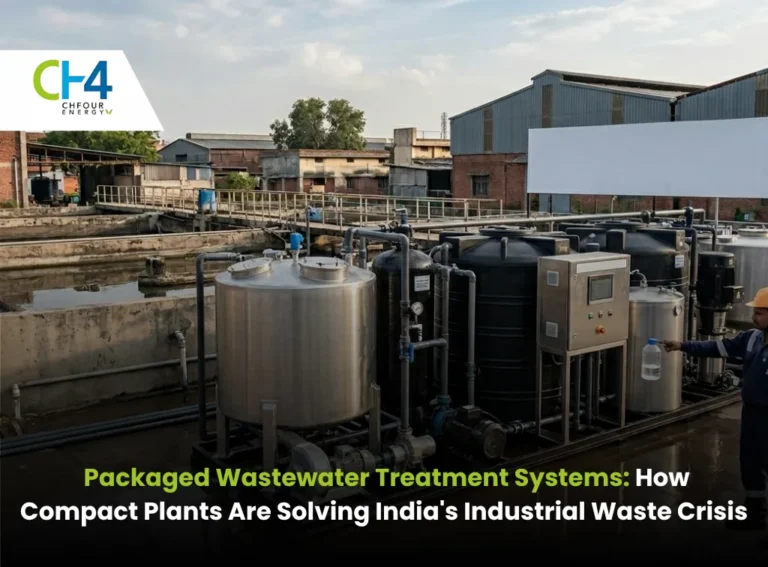
A Water Treatment Plant in the packaged format integrates all treatment process stages screening, equalisation, biological treatment, clarification, and disinfection within a pre-engineered, skid-mounted or containerised unit that arrives on site ready for connection and commissioning. The civil work required is minimal: a concrete plinth, utility connections, and access for delivery and maintenance. Treatment capacities typically range from 5 KLD to 500 KLD for standard packaged configurations, with larger modular setups available by combining units. The biological treatment core in most modern packaged systems uses either Moving Bed Biofilm Reactor (MBBR) or Sequencing Batch Reactor (SBR) technology both proven in Indian conditions and suited to compact footprints.
Packaged STP vs Packaged ETP — The Key Distinction
Packaged Sewage Treatment Plants are designed for domestic and mixed wastewater from hotels, hospitals, residential complexes, and commercial buildings. They address BOD, TSS, and coliform to CPCB general standards for discharge or reuse. Packaged Effluent Treatment Plants are designed for industrial process wastewater carrying higher and more variable pollutant loads COD, heavy metals, TDS, colour, and industry-specific contaminants that require a treatment train tailored to the specific effluent profile. A packaged STP applied to industrial effluent will not achieve compliance. The treatment process must be selected for the specific contaminants present, not for the general category of wastewater.
The Advantages of Compact Plants Over Conventional Treatment Infrastructure
The case for packaged systems over conventional civil ETPs is not simply about capital cost it is about a set of operational and commercial advantages that are particularly relevant to Indian industrial conditions.
Speed, Footprint, and Capital Efficiency
Commissioning timeline: a packaged system can be operational in six to twelve weeks from order placement. A conventional civil plant requires twelve to eighteen months at minimum. For industries facing regulatory compliance deadlines, this difference is decisive. Land footprint: a packaged system treating 50 KLD may occupy 50 to 80 square metres. A conventional plant treating the same flow typically requires 300 to 500 square metres, a constraint that eliminates the conventional option for most MIDC and industrial estate sites. Capital cost: packaged systems typically cost 30 to 50 percent less than equivalent-capacity conventional plants when total project cost is compared, because the civil construction component often the largest cost driver in a conventional plant is eliminated entirely.
Mobility, Scalability, and Factory-Tested Performance
A containerised packaged system can be relocated if the facility moves or closes, which means it retains asset value rather than being written off as part of a building. Capacity can be increased by adding modules rather than rebuilding infrastructure, which matters for industries whose production volumes are growing. Factory-tested performance is a practical advantage that conventional plants do not offer: packaged systems are tested and commissioned at the manufacturer’s facility before delivery, reducing site commissioning risk and providing documented performance baselines for regulatory submissions to State PCBs.
Industries and Applications Where Compact Systems Are Delivering Results
The range of Indian industries and institutions now using packaged systems reflects how broadly the compact format fits India’s industrial geography.
Manufacturing Sectors With High Effluent Compliance Pressure
Pharmaceutical manufacturing carries CPCB Red category classification with strict discharge limits for API residues and organic loading. A Packaged Wastewater Treatment System based on MBBR technology with tertiary treatment delivers compliance for mid-sized pharma units without centralised CETP access. Food and beverage processing generates high-BOD effluent from dairy, meat, and fruit processing operations compact anaerobic-aerobic treatment trains achieve required BOD reduction within the footprint constraints of food processing facilities. Textile dyeing and finishing requires colour removal and COD reduction to among the most demanding discharge standards in Indian industrial regulation packaged systems with advanced oxidation or electrocoagulation stages address colour-specific limits that biological treatment alone cannot meet.
Sector Applicability — Packaged Treatment Systems in India
| Industry | Effluent Type | Treatment Technology | Application |
| Pharmaceutical | API residues, high COD | MBBR + tertiary polishing | Compliance discharge / ZLD |
| Food & Beverage | High BOD, fats, oils | Anaerobic + aerobic | Discharge / process water reuse |
| Textile / Dyeing | Colour, COD, TDS | Electrocoagulation + MBBR | Colour discharge compliance |
| Hospitals | Pathogens, pharma residues | SBR + UV disinfection | Safe discharge / reuse |
| Construction / Remote | Domestic sewage | Containerised SBR | Temporary site compliance |
Infrastructure, Institutional, and Remote Applications
Hospitals and healthcare facilities generate wastewater with infection control requirements and pharmaceutical residues that make sewage treatment a regulated category. Packaged STPs with UV disinfection are the standard solution for mid-sized hospitals outside municipal sewage networks. Hotels and resorts in eco-sensitive zones operate under NGT discharge restrictions that make treated water reuse the only viable operating model. Construction camps, highway projects, and mining sites generate significant wastewater with no infrastructure access containerised packaged STPs are mobilised with the project and demobilised on completion, which no conventional infrastructure can accommodate.
The Regulatory Framework — What CPCB and State PCBs Expect
A system that meets engineering specifications but does not satisfy the applicable regulatory requirements is not a compliance solution it is an incomplete installation.
CPCB Discharge Standards and State PCB Variations
Every Water Treatment Plant installed in India to achieve regulatory compliance must be designed against the specific standards applicable to its sector and location not only the CPCB General Standards for Discharge of Environmental Pollutants, which set the national floor, but also the State PCB sector-specific schedules that in many cases impose stricter limits. Maharashtra MPCB, Gujarat GPCB, Tamil Nadu TNPCB, and Telangana TSPCB each maintain sector-specific discharge schedules that may require lower effluent concentrations than CPCB general standards. The applicable state standard must be confirmed before the treatment train design is finalised.
Consent to Operate, Online Monitoring, and Documentation
Industries in the Red and Orange categories under CPCB’s environmental categorisation are required to obtain Consent to Establish and Consent to Operate from the relevant State PCB. The packaged system must be specified in the consent application with treatment capacity, process description, and expected effluent quality. CPCB mandates online Continuous Effluent Monitoring Systems for large and medium industries, and the packaged plant must include monitoring points compatible with CEMS installation from the outset. CH Four Energy Solutions supports clients through consent documentation, PCB inspection preparation, and CEMS integration as part of the full project scope.
What to Evaluate Before Procuring a System
Selecting a packaged system on the basis of capacity and price alone without evaluating the treatment process against the actual effluent profile is the most common reason packaged installations fail to achieve compliance.
Technical Evaluation Criteria
Effluent characterisation must precede process selection. A representative sample analysis covering BOD, COD, TSS, TDS, pH, heavy metals, and industry-specific parameters is the minimum requirement before any Packaged Wastewater Treatment System is specified. A system designed without this data will not reliably achieve the required effluent quality under real operating conditions. Treatment process selection must match the specific contaminant profile: MBBR for high-BOD organic streams; physico-chemical treatment for metal-bearing effluents; advanced oxidation for colour and refractory organics; anaerobic pre-treatment for high-strength streams before aerobic polishing. Peak load handling is as important as average design flow industrial effluent generation varies by production shift, season, and product mix, and the system must be sized for peaks, not means.
Supplier and Project Delivery Criteria
Sector-specific installation references are the most reliable indicator of a supplier’s capability for a given application. A supplier who has installed and commissioned systems in the same industry with the same effluent profile carries meaningfully lower delivery risk than one whose experience is in a different sector. Factory acceptance testing documentation should be requested and reviewed before any system is dispatched test certificates alone are insufficient; the interpreted results against the design specification are what matter. Post-commissioning O&M support is the criterion that most procurement processes underweight: a packaged system that achieves compliance at commissioning but drifts out of compliance six months later due to inadequate operational support has not delivered its purpose.
Zero Liquid Discharge and the Next Generation of Compact Treatment
Compliance with discharge standards is the minimum requirement for a growing number of Indian industries, zero liquid discharge is becoming an operational necessity rather than a regulatory aspiration.
Why ZLD Is Becoming a Practical Requirement
Industries in the textile, pharmaceutical, and chemical sectors across Rajasthan, Gujarat, Maharashtra, and Tamil Nadu are operating under NGT and State PCB orders requiring ZLD implementation. Water tariff increases and groundwater withdrawal restrictions are making treated water reuse economically rational even where a ZLD mandate does not yet exist recycling treated effluent reduces freshwater consumption and lowers operating cost in a way that a discharge-only treatment system cannot. Compact ZLD systems combining biological treatment with membrane filtration and evaporation are now available in packaged formats, extending the pre-engineered model to the full treatment-and-reuse cycle.
How CH Four Energy Solutions Approaches ZLD and Packaged Treatment
CH Four Energy Solutions designs and delivers integrated Water Treatment Plant solutions across the full treatment spectrum from standard packaged ETPs and STPs for compliance discharge through to complete ZLD systems with tertiary polishing and water recovery for reuse. The design process begins with effluent characterisation and regulatory requirement mapping, producing a treatment train that is matched to the actual contaminant profile and the applicable State PCB standards before any equipment is specified. End-to-end project responsibility covering design, supply, installation, commissioning, and post-commissioning O&M support means the system performs to specification from commissioning through the full operating lifecycle.
Conclusion
India’s industrial wastewater compliance challenge is not primarily a technical problem. The treatment technologies that achieve compliance are well-established and proven. The challenge is one of access making effective treatment available to the industries, sites, and operating scales that conventional civil ETP infrastructure was never designed to serve. Compact, pre-engineered packaged systems have changed that access equation significantly over the last decade, and the range of industries and applications they now serve in India reflects how broadly that shift has taken hold.
The condition that determines whether a packaged system delivers its compliance promise is the same condition that determines whether any treatment system works: process selection matched to effluent characterisation, regulatory requirements confirmed before design is fixed, and a supplier with the sector-specific experience to commission the system to specification and support it in operation. When those conditions are met, the compact plant format delivers compliance outcomes that conventional infrastructure cannot match on the terms that Indian industry actually operates on. Contact us at +91 8055573883 and our team will guide you with every step of the process.