
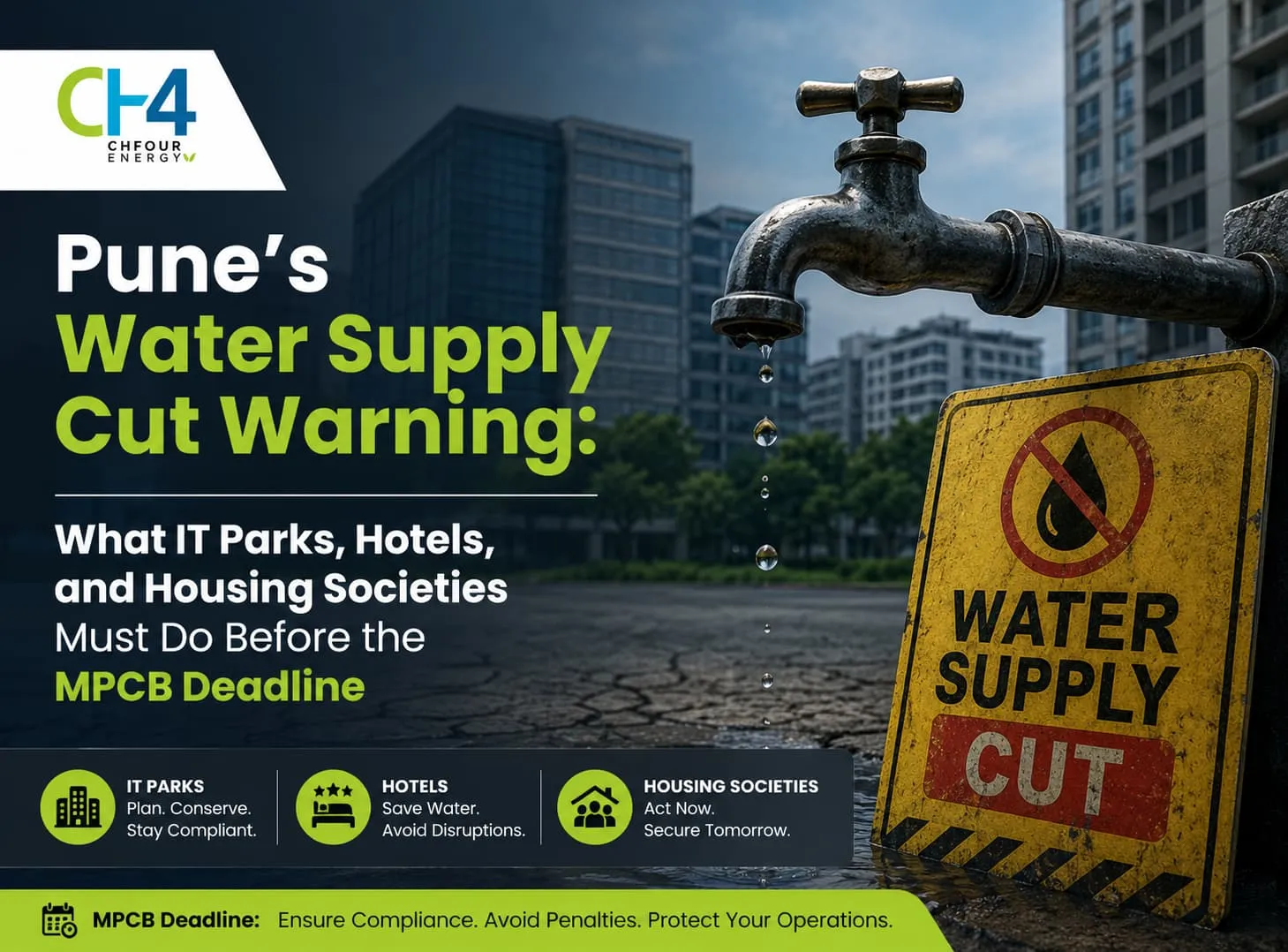
Pune’s Water Supply Cut Warning: What IT Parks, Hotels, and Housing Societies Must Do Before the MPCB Deadline
In May 2026, the Pimpri Chinchwad Municipal Corporation disconnected water supply to 24 housing societies in Pune without hesitation. These were not new projects or unknown buildings they were established residential complexes that had simply failed to keep their sewage treatment infrastructure operational and compliant. MPCB enforcement teams are now conducting inspections in phases across the Pune Metropolitan Region, and authorities have confirmed that this is not a one-time warning. More disconnections are coming. If you manage an IT park, operate a hotel, or sit on the committee of a housing society, the time to act is right now before an inspector walks through your gate. This blog breaks down exactly what you need to do, sector by sector, to stay compliant and keep your water supply intact. What Is Driving Pune’s Water Compliance Crackdown in 2026? The enforcement pressure did not come out of nowhere. It has been building steadily, and the May 2026 PCMC action was simply the most visible outcome of a longer regulatory push. The Scale of the Problem Across the City Pune generates enormous volumes of sewage daily across its residential, commercial, and industrial zones. A significant portion of this sewage ends up undertreated or completely untreated because the plants installed on premises are either non-functional, undersized, or running without valid MPCB consent. The Maharashtra Pollution Control Board has repeatedly flagged this as a critical compliance gap. When PCMC prepared its list of defaulters earlier this year, it found 62 housing societies in violation after just one round of inspections. How the MPCB Deadline Works The MPCB sets compliance timelines as part of its Consent to Establish and Consent to Operate framework. Once a notice is issued, the establishment is given a specific window to respond and demonstrate corrective action. Failure to respond or show progress results in escalated action which now includes water supply disconnection, stop-work orders, and monetary penalties. The regulatory machinery is active, and ignoring a notice in 2026 is not a strategy. What IT Parks Must Do Right Now IT parks in Pune present a unique compliance challenge because they typically have higher occupant density than their original STP design anticipated, combined with a tendency to outsource plant operations to third-party contractors without adequate oversight. Audit Your STP Against Current Load The Rajiv Gandhi Infotech Park in Hinjawadi is a textbook example of what not to do. MPCB found that the park’s STP was designed to process 4 megaliters per day but was actually handling just 1.5 megaliters. Multiple sections were non-operational, storage tanks were in disrepair, and the treated water was being discharged into the Mula River rather than reused. The result was fish deaths, environmental contamination, and three MPCB notices in three months. Run an honest audit of your current daily sewage load versus what your plant was originally sized to handle. If your tenant count or occupied area has grown since the plant was commissioned, there is a strong chance your current infrastructure is undersized. A Packaged Wastewater Treatment System is one of the fastest and most practical ways to address a capacity gap these modular, plug-and-play units can be deployed quickly without large-scale civil construction, making them ideal for IT parks where downtime and space are both constraints. Review Your MPCB Consent Validity and O&M Agreement Many IT park operators assume that obtaining the original Consent to Operate was a one-time formality. It is not. Consents expire and must be renewed on schedule. Check your current consent validity on the ec-MPCB portal immediately. Additionally, ensure your Operation and Maintenance agreement with your STP contractor covers daily log maintenance, monthly treated water quality reports, and sludge disposal records because these are exactly what an MPCB inspector will ask for during a surprise visit. What Hotels and Hospitality Businesses Need to Address Hotels face a dual compliance obligation that many operators underestimate they generate both sewage from guest rooms and laundry, and food-based effluent from kitchens and banquet operations. STP Alone May Not Be Enough Depending on the scale of kitchen operations, a hotel may require a separate effluent treatment stream for its food waste. MPCB has issued notices to hotels and resorts across Maharashtra specifically for operating without adequate pollution control systems, not just for missing paperwork. If your property has not had an independent technical review of its wastewater treatment infrastructure in the last 12 months, commission one. A functional Water Treatment Plant that covers both sewage and kitchen effluent streams, designed to MPCB-approved standards, gives you the compliance foundation and protects your licence to operate. Document Your Treated Water Reuse This is the step most hotel operators skip. Treated water from your STP must be actively reused for garden irrigation, toilet flushing, cooling tower makeup, or car wash bays and that reuse must be logged. MPCB inspectors check for reuse records as part of their site review. Hotels that demonstrate active treated water reuse, with monthly volume logs, are in a significantly stronger compliance position than those who simply claim it happens. What Housing Society Committees Must Do Before the Deadline The PCMC water disconnection action in May 2026 was aimed almost entirely at housing societies. If your residential complex has a built-up area exceeding 20,000 square metres or daily water consumption above 20,000 litres, you are legally mandated to operate a functional STP and reuse the treated output. Check If Your STP Is Running or Just Sitting There A very common situation across Pune housing societies is an STP that was installed to obtain the Occupancy Certificate but has since been switched off to reduce electricity costs. This is a serious compliance violation. Authorities verify operational status during inspections of a plant that exists on paper but is not running counts as non-compliance. If your plant has been inactive, restart it with professional support and get the outlet parameters tested before an inspector arrives. Respond to Notices Immediately — With a Written Action Plan If your society has already received a notice from MPCB