
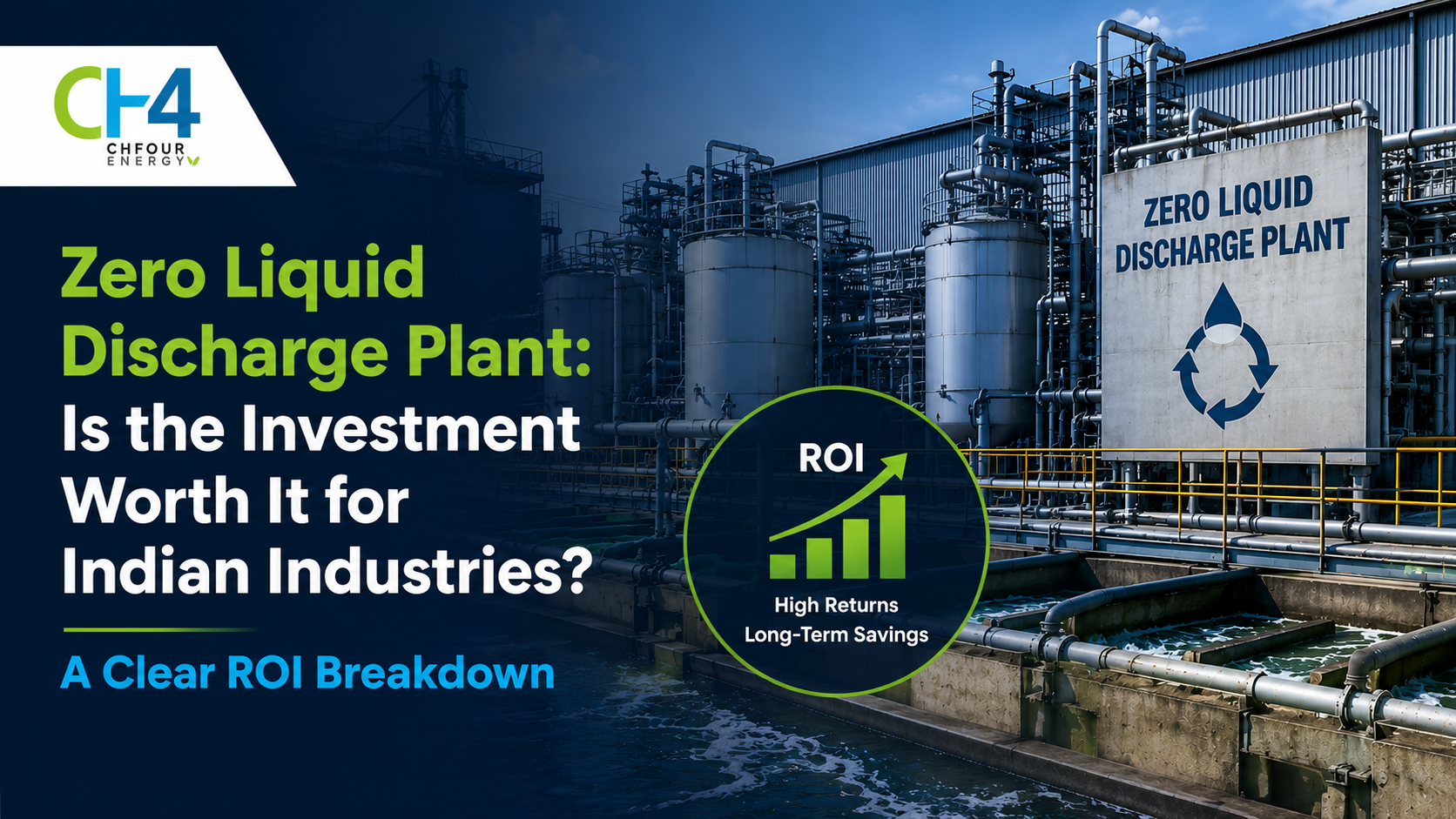
Zero Liquid Discharge Plant: Is the Investment Worth It for Indian Industries? A Clear ROI Breakdown
A Zero Liquid Discharge System costs 4 to 5 times more than a conventional effluent treatment plant. For a 100 KLD capacity installation, the initial investment begins at ₹1 to 1.5 crore and for larger industrial units in pharma, textiles, or chemicals, that figure climbs considerably higher. On the face of it, the capital case looks difficult to justify. But that comparison misses the full picture. For industries in mandated sectors textiles, pharmaceuticals, tanneries, distilleries, and chemical manufacturers the question is no longer whether to invest. The question is whether the numbers actually work in your favour over time. For a growing number of Indian industries operating in water-stressed regions under increasing CPCB enforcement, they do. The Indian ZLD market is projected to cross ₹1,750 crore in 2026, and the growth is not driven by goodwill, it is driven by financial and regulatory reality. Which Indian Industries Are Legally Required to Have a ZLD Plant Understanding where the mandate applies is the first step before evaluating any financial case. Sectors Where ZLD Is Non-Negotiable The Central Pollution Control Board has identified specific sectors where a ZLD Plant is compulsory textile dyeing and processing units, pharmaceutical companies generating chemical-laden effluent, distilleries with high-BOD spent wash, tanneries handling chromium-laden wastewater, and chemical manufacturing plants in critically polluted areas. These industries cannot obtain or renew their Consent to Operate without demonstrating a functional zero discharge system. Textile clusters in Tirupur, Panipat, and Bhilwara and tannery clusters in Kanpur and Unnao have already faced closure notices and water connection disconnections for non-compliance. Industries Adopting ZLD Proactively Beyond the mandatory categories, food processing units, automotive manufacturers, power plants, and export-oriented facilities are increasingly adopting ZLD ahead of regulatory compulsion. The 2026 Draft Extended User Responsibility guidelines now require bulk water users drawing from borewells or municipal lines to demonstrate a defined level of water neutrality and a functional zero discharge system is the most direct path to achieving that status. EU and US buyers are also demanding ZLD certification as part of supply chain due diligence, making compliance a commercial requirement for export markets. What Does a ZLD Plant Actually Cost in India? The honest answer requires separating capital cost from total cost of ownership two numbers that rarely receive equal attention. Capital Investment — The Variables That Move the Number A Zero Liquid Discharge System at 100 KLD starts at ₹1 to 1.5 crore for membrane-based configurations. Thermal systems which use Multi-Effect Evaporators and crystallisers to handle high-TDS effluent streams cost more, but they handle what membranes alone cannot. The key cost variables are plant capacity, effluent complexity (pharmaceutical API streams cost more to treat than standard textile effluent), automation level, and whether the system is being built fresh or retrofitted onto an existing ETP. Operating Costs — The Number Most Leaders Underestimate OPEX generally runs from ₹80 to ₹150 per kilolitre of treated water. Energy is the dominant driver, consuming 80–100 kWh per cubic metre in thermal stages compared to just 0.5–1.5 kWh/m³ for conventional biological treatment. Chemical dosing, membrane replacement, sludge and salt disposal through authorised TSDF facilities, and O&M staffing make up the remainder. The good news is that hybrid membrane-thermal configurations and IoT-based dosing optimisation can reduce total OPEX by 15 to 22 percent compared to a poorly managed conventional thermal plant. The ROI Case — Where the Investment Pays Back Three distinct savings streams drive the financial return, and most ROI calculations only account for one of them. Freshwater Cost Savings — The Primary Driver ZLD systems recover 90 to 95 percent of water for internal reuse. In water-stressed industrial clusters, freshwater procurement costs range from ₹17/m³ in Ichalkaranji to ₹75/m³ in Tirupur. For a unit processing even 500 m³/day and recovering 90 percent, the annual freshwater saving at the lower cost bracket is substantial and at tanker rates during supply disruptions, which can be 3 to 5 times the standard municipal rate, the numbers improve significantly further. Byproduct Recovery — Turning Waste Into Revenue Many ZLD systems recover salts, minerals, and chemicals that can be sold or reused directly in production. Textile units recover sodium sulphate for reuse in dyeing processes, tanneries reclaim chromium for leather processing, and chemical plants extract valuable compounds from brine streams. This byproduct revenue is not speculative it directly reduces raw material procurement costs and partially offsets OPEX in the same financial period. Avoided Compliance Costs — The Calculation Most Plants Skip This is the savings stream that changes the financial case most dramatically. For industries in mandated sectors, operating without a compliant ZLD Plant means CTO cancellation risk, NGT-directed penalties under the Polluter Pays Principle that have run into crores for water body contamination cases, water supply disconnection, and production halts. None of these appear in a standard OPEX model but they are real, documented outcomes for identifiable facilities across India. The cost of a single enforcement action routinely exceeds the annual OPEX of a well-run ZLD system. Payback Timeline — What the Data Shows Capital cost is 4–5x a standard ETP, but freshwater savings and regulatory security typically deliver payback within 3 to 5 years. Chemical manufacturing units at 100 KLD have demonstrated returns in as little as 2.8 years. For textile mills using AI-optimised ZLD operations, payback from steam savings and membrane replacement avoidance alone has been recorded at 9 to 14 months. The variables that shorten payback most are: high local freshwater cost, large effluent volume, byproduct recovery potential, and the size of the compliance risk being mitigated. What Causes ZLD Plants to Underperform — And How to Avoid It Most ZLD investment failures are not technology failures they are design, sizing, and O&M failures. Poor Pre-Treatment and Undersizing Inadequate pre-treatment is the single most common cause of ZLD underperformance. Membranes foul rapidly, RO recovery rates drop, energy costs rise, and the plant fails to hit its designed water recovery targets. Equally common is undersizing a plant designed for projected effluent volumes that the facility subsequently exceeded. An