
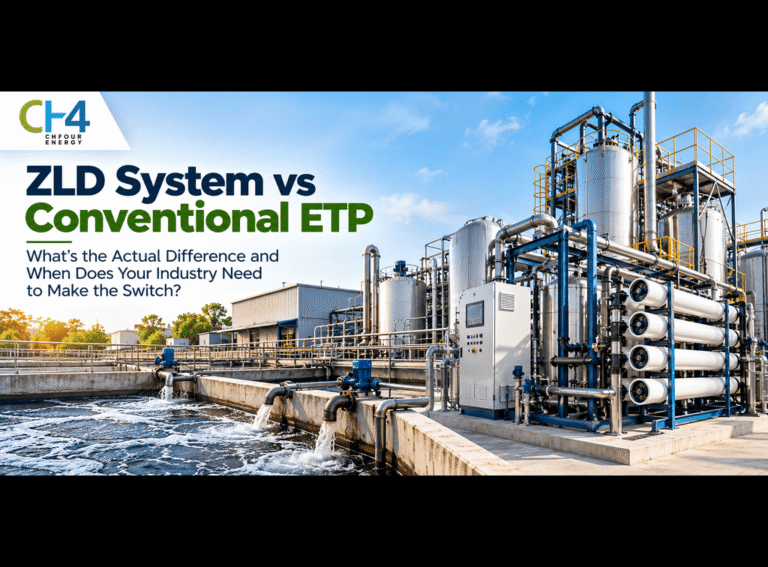
Most industries already run an Effluent Treatment Plant. It treats wastewater and brings it within the discharge limits set by the pollution control board. Today, water costs are rising and regulators are asking for more. A Zero Liquid Discharge System is now part of that conversation. At CH Four Energy Solutions, we design and support both options. This blog explains how they differ and when a switch makes sense.
What Is a Conventional ETP and What Does It Do?
Let us start with the system most plants already have.
How an Effluent Treatment Plant Works
An Effluent Treatment Plant cleans industrial wastewater in stages. Primary treatment removes solids, oil, and grease through screening and settling. Secondary treatment uses bacteria to break down organic matter. Tertiary treatment polishes the water using filters or disinfection. The treated water is then discharged or reused for gardening and cooling. Most ETPs are built to meet standard norms for pH, BOD, COD, and suspended solids.
Where a Conventional ETP Falls Short
An ETP does not remove dissolved salts well. Total dissolved solids, or TDS, stay in the water after treatment. Colour and hard COD can also pass through. When norms get tighter, these gaps lead to consent issues, notices, and penalties. This is the gap a ZLD Plant is built to close.
What Is a ZLD System and How Is It Different?
A ZLD system goes much further than an ETP.
The Idea Behind Zero Liquid Discharge
As the name says, a Zero Liquid Discharge System sends no liquid waste out of the site. Every drop of wastewater is treated and recovered. The water goes back into the process. The dissolved salts are separated as solids and disposed of safely.
Main Stages of a ZLD Plant
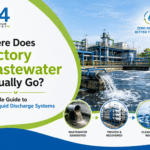
A ZLD Plant usually begins with an ETP as its front end. The treated water then passes through reverse osmosis, which recovers most of the water. The reject stream, which carries the salts, goes to an evaporator. A crystallizer or agitated thin film dryer turns the final concentrate into solid residue. This is why ZLD is a larger and costlier setup than a standalone ETP.
ZLD vs ETP Key Differences
The two systems solve different problems, and the gap shows up in a few clear areas.
Water Recovery and Reuse
A conventional ETP allows limited reuse and discharges the rest. A ZLD system recovers nearly all the water for reuse. This cuts fresh water intake in a big way.
Cost, Energy, and Space
An ETP costs less to build and run. ZLD needs more capital, more energy, and more land because of the evaporation stage. Water savings offset part of these costs over time.
Waste Handling
An ETP produces sludge. A ZLD system produces sludge and salt residue. Salt disposal needs planning and authorised handling. Plants must account for this before choosing ZLD.
When Should Your Industry Switch to ZLD?
The decision depends on rules, water supply, and the quality of your treated effluent.
Regulatory Triggers
Some pollution control boards direct certain industries to adopt ZLD. This often applies to textile, dyeing, distillery, and chemical units. A direction in your consent order is the clearest sign.
Water and Operational Triggers
Frequent tanker purchases show a water supply problem. Rising water bills point the same way. When borewell levels fall, reuse becomes more valuable. In these cases, a ZLD Plant can pay back through water recovery.
Technical and Business Triggers
High TDS in treated water is a technical warning. Repeated failures in discharge tests are another. On the business side, export buyers and ESG reports now ask about water practices.
Which Industries Usually Need ZLD?
Needs vary by sector, so it helps to look at where ZLD is most common.
Sectors Where ZLD Is Common
Textile processing, pharmaceuticals, bulk drugs, specialty chemicals, distilleries, and some power and steel units commonly require it. Their wastewater carries high salts and hard to treat organics.
Sectors Where an ETP Is Often Enough
Engineering units, auto component makers, and many food units often manage with a well run Effluent Treatment Plant. For them, the better step is to upgrade and maintain the existing plant before thinking about ZLD.
Mistakes to Avoid When Moving From ETP to ZLD
Many plants hurry this decision, and that is where the trouble starts.
Skipping the Fix on the Existing ETP
A ZLD system depends on the ETP ahead of it. A weak ETP sends poor quality water to the RO and fouls the membranes. Stabilise the ETP first.
Ignoring Segregation and Salt Disposal
Mixing high TDS streams with low TDS streams raises the load on evaporators. Segregating at source lowers cost. Salt disposal also needs a clear plan from day one.
How CH Four Energy Solutions Can Help
We look closely at your plant before we recommend anything.
Our Approach to ETP and ZLD
At CH Four Energy Solutions, we start with a study of your effluent, flow, and consent conditions. Some plants need an upgrade to their Effluent Treatment Plant. Others need a full ZLD Plant. We tell you which one fits, and we do not push a bigger system than you need.
Conclusion
An ETP treats wastewater to meet discharge norms. A Zero Liquid Discharge System removes discharge altogether and recovers the water. The right choice depends on your regulations, water situation, and effluent quality. Deciding early saves cost and avoids compliance trouble later.
Talk to CH Four Energy Solutions
Request a plant assessment and get clear advice on your Effluent Treatment Plant or ZLD Plant needs. Contact our team at 8055573883 to get started.