
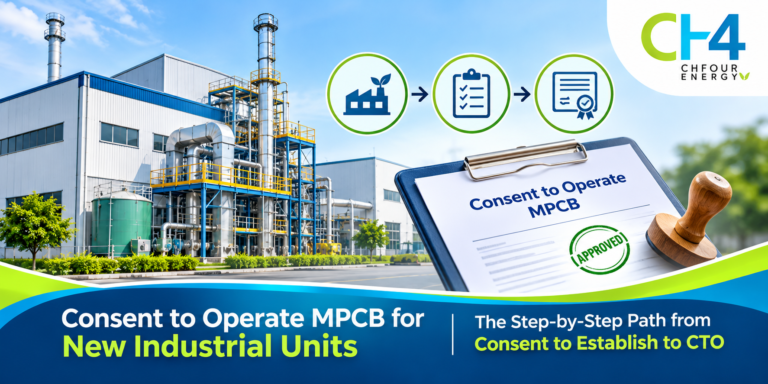
Many new unit owners build first and think about consents later. That order causes delays, notices, and a late start to production. Getting Consent to Operate MPCB is a legal requirement before any industry begins running. It follows a Consent to Establish and depends on how well your site and pollution control systems are prepared. At CH Four Energy Solutions, we guide new units through every stage. This blog explains the full path in simple steps.
Understanding MPCB Consents for a New Unit
The Maharashtra Pollution Control Board issues two main consents to a new unit.
Consent to Establish
Consent to Establish, or CTE, is the first approval. You need it before you start construction or install machinery. The Board reviews your site, your process, and your plan for pollution control.
Consent to Operate
Consent to Operate, or CTO, comes after the unit is built. The Board checks that your installed systems match the approved plan. Consent to Operate MPCB permits you to start production. It is valid for a fixed period and must be renewed.
Does Your Unit Need Consent
The Board sorts industries by their pollution potential.
Red, Orange, Green, and White Categories
Red category units carry the highest pollution load and face the closest review. Orange and green units follow in that order. White category activities are largely exempt from consent. Your category decides the timeline and the depth of scrutiny.
How to Check Your Category
The Board publishes category lists based on activity and product. Check your exact process against the list. If you are unsure, an experienced MPCB Consultant can confirm the category before you apply.
Before You Apply, Check Site and Zoning
Some checks must be settled before any application is filed.
Land Use and Industrial Zone
Confirm that the land is approved for industrial use. Plots in a recognised industrial area are easier to clear. Other plots may need extra permissions.
Siting Conditions and Other Approvals
Certain industries must keep a set distance from homes, water bodies, or protected areas. Some projects also need environmental clearance first. Settle these points early to avoid rejection later.
Applying for Consent to Establish
The first application sets the base for everything that follows.
Documents Required
Prepare land documents, a site plan, and proof of incorporation. Add a detailed process description with raw materials and products. Include a water balance and the quantity of waste generated. Submit everything through the Board portal and pay the prescribed fee.
Pollution Control System Details
Show how you will treat effluent, sewage, air emissions, and hazardous waste. Include the design of your effluent treatment plant. A clear design reduces the number of queries from the Board.
Scrutiny and Grant of Consent to Establish
After submission, the Board studies your file and may visit the site.
What the Board Reviews
Officers check the site, the process, and the capacity of your control systems. They compare figures across documents. Any mismatch leads to a query.
Replying to Queries
Reply to every query on time and with complete data. Late or partial replies are a common reason for delay. Once satisfied, the Board grants the CTE with conditions.
Building the Unit and Pollution Control Systems
Construction must follow the plan that the Board approved.
Building to the Approved Plan
Do not change capacity, process, or layout without informing the Board. Changes can invalidate your consent.
Trial Runs and Testing
Install your treatment systems and run trials before you apply for the next stage. Collect test reports from an approved laboratory. These reports prove that your plant meets the limits. A reliable MPCB Consultant helps you organise this evidence in the format the Board expects.
Applying for and Receiving Consent to Operate
This is the final approval that lets production begin.
Documents and Test Reports
Submit the CTE copy, proof of installation, and treatment plant test results. Add authorisations for hazardous waste or other waste streams where they apply.
Inspection and Grant
Officers inspect the plant and check that the systems are running. They look at records, sample points, and housekeeping. After approval, the Consent to Operate MPCB carries conditions on discharge limits, monitoring, and returns.
Common Reasons for Delay or Rejection
Most delays come from avoidable mistakes.
Document and Design Gaps
Incomplete files and inconsistent figures slow the process. Pollution control systems that differ from the approved design also cause rejection.
Starting Production Early
Running the unit before the CTO is a violation. It can lead to notices, penalties, and closure directions. Wait for the consent in hand.
Compliance After You Get the CTO
Approval is only the beginning of your obligations.
Records and Returns
Maintain registers for operation, chemical use, and waste disposal. File the environmental statement and other returns on time.
Plan Renewal Early
Track the validity date and begin renewal well before expiry. A lapsed consent puts your production at risk.
Handling It Yourself or Hiring a Consultant
The right choice depends on your team and your timeline.
Where Expert Help Saves Time
A good MPCB Consultant knows the portal, the document formats, and the common queries. At CH Four Energy Solutions, we prepare applications, design the effluent treatment plant, and support you through inspection.
Conclusion
The path to Consent to Operate MPCB runs from site checks to CTE, installation, testing, and then CTO. Plan your pollution control systems early and keep your documents consistent. Follow the right order and your unit starts production without avoidable delay.
Talk to CH Four Energy Solutions
Get expert support for CTE, CTO, and effluent treatment plant setup. Visit chfour.net or contact CH Four Energy Solutions today and speak with an experienced MPCB Consultant about your project. Or contact our team at +91 8055573883 today.