
Every hotel kitchen in India pays two bills for the same food. First, an LPG bill to cook the meals. Then, a disposal bill to haul the leftovers away. Most properties accept this as normal. It is not.
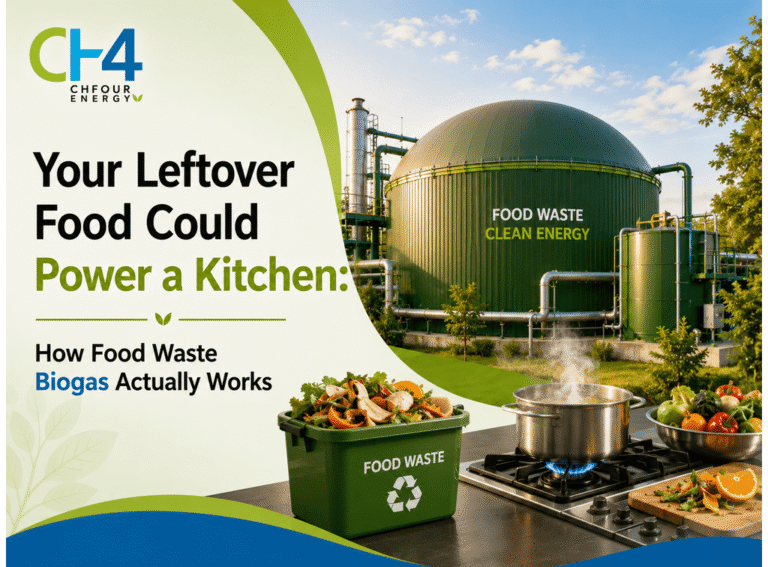
Hotels and restaurants across India are now installing Food Waste Biogas systems to break this cycle. The leftover food goes into a digester on the property. Biogas comes out. That gas is piped directly into the kitchen. The disposal cost drops. The LPG bill shrinks. And the property has a documented waste management process that satisfies Solid Waste Management Rules.
At CH Four Energy Solutions, we design and install these systems for hotels, housing societies, hospitals, and campuses across Pune and Maharashtra. This guide explains how the process works and what it delivers.
The Double Cost That Most Properties Are Still Paying
Food waste is expensive twice over, and most facility managers have not calculated both costs together.
Disposal Costs Add Up Every Single Day
A hotel generating 100 kg of food waste daily pays for collection, transportation, and landfill disposal 365 days a year. These costs are rising. Under the Solid Waste Management Rules, bulk waste generators producing more than 100 kg per day must manage organic waste on-site. Properties that continue to send it to landfills are increasingly receiving compliance notices from municipal bodies and MPCB in Maharashtra.
The LPG Bill That Does Not Need to Be That High
At the same time, the kitchen is burning through LPG cylinders every week. India imported LPG worth over Rs 1.06 lakh crore in 2024-25. Supply disruptions, price hikes, and distribution delays hit commercial kitchens hardest. Hotels, hospital kitchens, and housing society canteens are the most exposed to these fluctuations. Converting food waste into cooking gas directly reduces that exposure.
What Is Food Waste Biogas and How Does It Form
The science behind biogas is straightforward, and it happens naturally when organic matter breaks down without oxygen.
Bacteria Do the Work Inside the Digester
When food scraps, vegetable peels, cooked leftovers, and kitchen waste enter a sealed digester tank, bacteria consume the organic material. No oxygen is present. The bacteria produce methane as a byproduct. That methane is biogas. It is the same combustible gas that makes up LPG and natural gas. One tonne of food waste produces approximately 150 to 200 cubic metres of biogas under standard digester conditions.
What Goes In and What Comes Out
The inputs are everyday kitchen waste items. Cooked leftovers, raw vegetable trimmings, fruit peels, stale food, and canteen discards all qualify. The waste is shredded to reduce particle size before entering the digester. This speeds up bacterial breakdown and increases gas yield. Two outputs come from the process. The first is biogas, which goes to the kitchen. The second is digestate, a nutrient-rich organic slurry that works as a natural fertilizer for gardens and landscaping.
How a Biogas Plant Works Step by Step
The process follows a fixed sequence regardless of whether the plant is at a hotel, a housing society, or a corporate campus.
Waste Collection and Shredding
Kitchen staff segregate wet organic waste into dedicated bins at the source. The collected waste enters a shredder that reduces particle size to under 12mm. Smaller particles mean more surface area for bacteria to work on. Gas production begins faster and yields more per kilogram of waste.
The Digester Produces the Gas
The shredded waste enters the main digester as a slurry. Bacteria in the digester work through the organic material over a retention period of 15 to 20 days. The digester operates between 33 and 38 degrees Celsius. This temperature range keeps the bacterial population active and productive. Gas collects at the top of the sealed digester as it is produced.
Gas Purification and Kitchen Piping
Raw biogas contains hydrogen sulphide, which is corrosive to pipes and appliances. A scrubber removes it before the gas moves to storage. Clean biogas is stored in a gas holder that maintains steady pressure. From there, it is piped directly into the kitchen gas manifold. Kitchen staff use it the same way they use LPG. The two fuel sources can run in parallel with a simple switching arrangement.
How Much Gas Can Your Property Actually Produce
Output depends on daily waste volume, the organic content of that waste, and digester operating conditions.
Practical Output Numbers by Property Type
A hotel producing 100 kg of food waste daily generates enough biogas to replace several LPG cylinders per month. A housing society canteen producing 30 to 50 kg daily can cover a meaningful portion of its daily cooking fuel needs. A hospital kitchen generating 60 to 80 kg per day can run a dedicated gas supply line for kitchen use. A well-managed Canteen Waste Based Biogas Plant at a corporate campus or institution operates at this scale reliably once the daily waste stream is consistent.
What This Means for Your LPG Bill
Commercial biogas plants for hotels and institutions typically deliver a return on investment within 3 to 5 years. Savings come from fuel replacement, reduced waste disposal costs, and in some configurations, electricity generation from excess gas. The larger and more consistent the daily waste stream, the faster the payback.
Who Is Using Food Waste Biogas in India Right Now
This technology is not experimental. It is operational across multiple property types in India today.
Hotels and Restaurant Groups
Hotels and restaurant groups in Bengaluru, Pune, and other Indian cities have installed biogas systems to offset rising LPG costs. The kitchen integration is direct and does not require changes to cooking equipment. Biogas runs through the existing manifold alongside LPG. During peak kitchen hours, the biogas covers a fixed portion of fuel demand. The LPG cylinders last longer. The disposal vendor comes less often.
Housing Societies and Canteen-Heavy Campuses
Residential townships and housing societies that run shared canteens are strong candidates for a Canteen Waste Based Biogas Plant. Daily canteen waste from resident kitchens and common dining areas provides a consistent feed. The gas produced goes back into the canteen kitchen. In Maharashtra, this also helps societies meet MPCB and PMC organic waste management requirements, reducing the risk of compliance notices for bulk waste generators.
How CH Four Energy Solutions Delivers These Systems
The right outcome depends on the right design, not just the right technology.
We Start With a Waste Audit
Every CH Four project begins with a site visit and waste measurement exercise. We assess daily waste volume, composition, oil content, and peak production days. This data drives the plant sizing. A system sized correctly from day one produces at its designed capacity and delivers the expected gas yield consistently. Over-sized or under-sized systems do not perform to expectation and do not deliver the promised savings.
Full System Supply and Installation
CH Four Energy Solutions supplies and installs the complete system. This covers the shredder, digester, gas holder, purification unit, and kitchen piping integration. For properties in Maharashtra, we also manage MPCB compliance documentation, ensuring the biogas plant is registered as part of the property’s on-site organic waste management record. With over 15 years of experience and 1,500 completed projects across India, our team handles the full project under one accountability model.
Operation and Maintenance That Protects the Investment
A digester is a biological system. It needs daily feeding, temperature monitoring, and periodic cleaning. Our O and M contracts cover daily performance checks, biological health monitoring of the digester, scheduled maintenance, and monthly gas production and savings reports. The plant stays productive. The documentation stays audit-ready.
Conclusion
Every day a property pays to dispose of food waste and pays separately for cooking fuel, it is paying twice for a problem that one system can solve. Food Waste Biogas converts the disposal liability into a fuel source. The technology is proven. The use cases are operating across India. The regulatory pressure to manage organic waste on-site is increasing every year.
For hotels, housing societies, hospitals, and corporate campuses across Pune and Maharashtra, 2026 is the right time to make the switch. CH Four Energy Solutions has been designing and operating these systems since 2008. A free waste audit is where every project starts.
Get a Free Waste Audit for Your Property
We assess your daily waste volume, estimate gas output, and give you a clear picture of what a biogas system would cost and save. No obligation. No guesswork. Call us now at +91 80555 73883 and our experts will guide you through your requirements.