
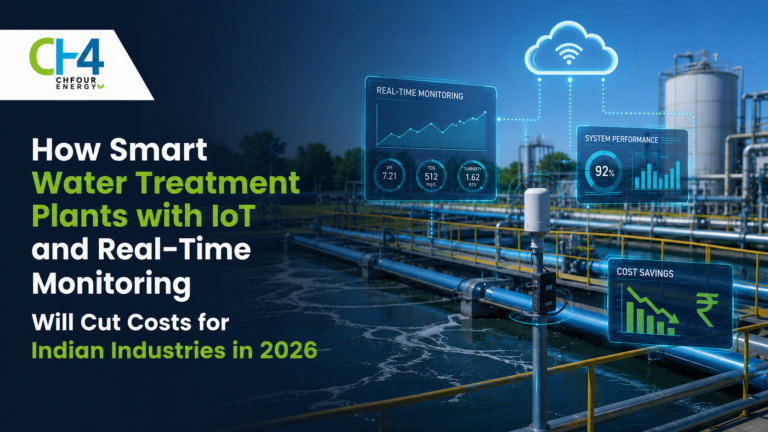
Most industrial ETPs and STPs across India are still being run on a reactive model. Samples are collected manually twice a day, sent to a lab, and results arrive 24 to 48 hours later. By the time a BOD spike shows up in a report, the non-compliant discharge has already left the plant. This is not just an operational inconvenience, it is a direct cost, and in 2026, it is also a serious regulatory risk. A Water Treatment Plant that cannot catch a process deviation until the following afternoon is one that will eventually generate a compliance notice.
The Central Pollution Control Board has mandated Online Continuous Effluent Monitoring Systems (OCEMS) for 17 categories of highly polluting industries, with real-time data transmitting directly to CPCB and SPCB servers. IoT-enabled treatment plants are no longer an upgrade for progressive companies they are becoming the operational baseline. And beyond compliance, they are delivering measurable cost reductions across chemical consumption, energy usage, and equipment maintenance.
Why the Traditional Treatment Model Is Costing Indian Industries More Than They Realise
The financial impact of running a manually operated plant goes beyond what appears on a monthly chemical bill.
Three Layers of Hidden Cost in Manual Plant Operations
Manual water treatment management carries three consistent cost drains that most plant managers do not calculate together. First, chemical overconsumption: without real-time load data, operators dose conservatively to avoid under-treatment which means dosing more than the actual load requires, on every shift, every day. Second, fixed aeration schedules that run at the same intensity regardless of biological oxygen demand, wasting significant electricity during low-load periods. Third, delayed detection of parameter deviations that result in compliance violations each of which carries a penalty cost that far exceeds what a sensor network would have cost to install.
CPCB OCEMS Mandate — Non-Compliance Is Now Automatic
For Red category industries, OCEMS data is timestamped and flagged on the CPCB portal in real time as “Live,” “Delay,” or “Offline.” A delay or offline status triggers a compliance notice automatically without any inspector needing to visit the site. MPCB and other SPCBs are now operating with this same digital visibility. Industries running without connected monitoring infrastructure are generating notices they do not even know about until the paperwork arrives.
What IoT Integration Looks Like Inside a Modern Treatment Plant
Understanding the architecture is essential before evaluating the cost case here is what a connected plant actually consists of.
A Sensor Network Across the Entire Process
IoT integration begins with placing smart sensors at the inlet, across key treatment stages, and at the outlet. pH probes, dissolved oxygen analysers, flow meters, turbidity sensors, and COD/BOD monitors track every parameter continuously. All data flows into a centralised cloud dashboard accessible from a phone, laptop, or control room giving operators complete plant visibility without walking the floor. For a Packaged Wastewater Treatment System deployed at a mid-size manufacturing unit or commercial campus, this sensor architecture can be built in during installation, making it compact, pre-wired, and operational within days of commissioning.
Automated Chemical Dosing and Demand-Responsive Aeration
The most immediate cost reduction from smart treatment comes from replacing manual dosing and fixed aeration schedules with automated, load-responsive controls. Sensors continuously assess incoming effluent quality and adjust chemical addition and blower intensity in real time. This eliminates two simultaneous problems: overdosing during low-load periods and under-treating during production peaks. Both are wasteful one in chemicals, the other in compliance risk. Plants that have integrated automated dosing consistently report 15 to 20 percent reductions in coagulant and pH correction chemical costs within the first operational year.
The Direct Cost Reductions IoT-Enabled Plants Are Delivering
The financial case for smart water treatment infrastructure is no longer theoretical documented outcomes from Indian and global industrial facilities make it concrete.
Energy Savings From Optimised Aeration
Aeration is typically the single largest energy cost in biological treatment systems. A fixed-speed blower running on a predetermined schedule consumes the same power regardless of actual biological oxygen demand at any given hour. Smart systems replace this with demand-responsive operation blower speed and runtime adjust to real-time dissolved oxygen readings in the aeration tank. Research and operational data from facilities that have made this transition consistently show energy cost reductions in the double-digit percentage range from aeration optimisation alone. For a large industrial plant processing several hundred kiloliters per day, this is a meaningful annual saving.
Reduced Compliance Penalties and Inspection Exposure
Every hour of compliant operation logged with a real-time timestamp builds the audit trail that regulators now demand. During an MPCB inspection or consent renewal, a plant with 12 months of continuous, clean OCEMS data is in a categorically stronger position than one presenting manual lab reports. Industry research indicates that facilities using IoT automation expect more than 20 percent reduction in compliance-related costs covering avoided penalties, reduced legal exposure, and faster consent renewal processing.
Predictive Maintenance — Stopping Failures Before They Cost You
Sensors continuously monitor equipment performance pump motor draw, diffuser backpressure, aerator current consumption and flag deviations that indicate early-stage wear before a breakdown occurs. A failed aerator that goes unnoticed for 12 hours can cause a biological treatment collapse and a direct compliance violation. Planned maintenance based on sensor-predicted wear is consistently cheaper than emergency repair, and it never creates an unplanned gap in treatment continuity.
Real Outcomes From Indian Industrial Facilities
The shift to smart treatment infrastructure is already producing measurable, documented results across the Indian industrial sector.
11% Daily Water Usage Reduction at an Indian Beverage Plant
A documented case study from an Indian beverage manufacturing facility showed that real-time monitoring identified water overconsumption hotspots across the production line data that was simply invisible under the previous manual monitoring regime. The corrective measures that followed reduced daily water consumption by 11 percent. Critically, the same IoT infrastructure that produced compliance data also revealed where process water was being wasted before it even reached the treatment plant, delivering savings well beyond the ETP itself.
Zero Compliance Violations With a 29% Drop in Water Consumption
A 2026 sustainability report from an industrial facility that integrated smart water management documented a 29 percent reduction in total water consumption and significant energy savings while maintaining zero compliance violations for effluent discharge throughout the reporting period. The combination of real-time monitoring, automated process controls, and continuous digital documentation made the facility permanently audit-ready, not just compliant during scheduled inspection windows.
Which Industries in India Gain the Most From Smart Treatment
Different sectors face different effluent challenges IoT monitoring addresses each in a specific, practical way.
Pharmaceutical and Chemical Manufacturing
Pharmaceutical units generate high-COD, high-TDS effluent that shifts rapidly in composition between batch cycles. Manual sampling twice a day cannot track these shifts with the precision required. Continuous IoT sensors that monitor COD, TDS, and pharmaceutical-specific parameters in real time give these plants the process visibility to stay within MPCB and CPCB permitted limits through every batch changeover.
Food, Beverage, and Dairy Processing
High organic loads, fluctuating BOD from batch processing, and fat-oil-grease management are the persistent compliance challenges in this sector. Automated inlet monitoring with dynamic dosing controls handles the variability that manual systems consistently miss and builds the treatment log that inspectors expect to see during surprise site visits.
IT Parks, Hotels, and Commercial Campuses
For commercial properties under MPCB’s STP compliance mandate, a Packaged Wastewater Treatment System with integrated IoT monitoring serves a dual purpose. It treats sewage efficiently in a compact footprint, and its sensor outputs generate the treated water quality records and reuse volume logs that MPCB inspectors specifically look for during unannounced visits. Manual record-keeping is replaced entirely by automated, timestamped data removing human error from the compliance documentation chain.
How CH Four Energy Solutions Delivers Smart Water Treatment for Indian Industries
Being cost-efficient and compliance-ready simultaneously requires the right technical partner, not just the right equipment.
IoT-Enabled ETP and STP Design, Installation, and Retrofitting
CH Four Energy Solutions designs and installs MPCB-approved ETPs and STPs for manufacturing units, pharmaceutical facilities, hotels, hospitals, and IT parks across Pune and Maharashtra. Every new installation includes IoT sensor integration across pH, BOD, COD, TSS, dissolved oxygen, flow rate, and sludge parameters connected to a cloud dashboard that gives plant managers real-time visibility and generates the compliance documentation trail automatically. For existing plants, IoT sensors and monitoring systems can be retrofitted without major civil reconstruction, turning a conventional Water Treatment Plantcg into a connected, smart facility without requiring a full replacement.
OCEMS Installation and CPCB Portal Integration
For Red category industries under the CPCB OCEMS mandate, CH Four manages the complete installation of sensor placement, calibration, PTZ camera integration, geotagging, and direct real-time data transmission to the CPCB RTDMS portal. This removes the compliance gap that catches industries off-guard: having a functional plant but missing the reporting infrastructure that regulators now actively enforce.
Operation and Maintenance That Keeps Smart Systems Performing
CH Four’s O&M contracts for IoT-enabled plants cover daily operational monitoring, monthly parameter reports, predictive maintenance scheduling based on sensor data, and annual compliance filing support. The documentation generated through this contract is the same audit-ready record that protects clients during MPCB surprise inspections and consent renewals with over 15 years of experience and 1,500+ completed projects across Maharashtra backing every engagement.
Conclusion
Indian industries running manual, reactive water treatment operations in 2026 are carrying a cost that compounds daily in chemical waste, in energy inefficiency, and in the regulatory exposure of operating without the continuous monitoring infrastructure that CPCB and state pollution control boards now actively enforce. Smart, IoT-enabled water treatment plants address all three simultaneously, and the documented cost reductions across Indian and global facilities confirm that the return on investment is clear and measurable.
Whether your facility needs a new IoT-integrated ETP installation, a Packaged Wastewater Treatment System for a commercial campus, OCEMS setup for CPCB compliance, or a smart retrofit of an existing plant, CH Four Energy Solutions has the technical depth and Maharashtra-specific regulatory experience to deliver it. The question in 2026 is not whether to upgrade, it is whether to upgrade before an inspector arrives or after.
Call Us now at +91 8055573883 and our team will guide you through the process.